



- 资源介绍
- 下载记录
- 用户评价
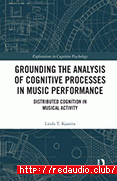
Through the systematic analysis of data from music rehearsals, lessons, and performances, this book develops a new conceptual framework for studying cognitive processes in musical activity.
Grounding the Analysis of Cognitive Processes in Music Performance draws uniquely on dominant paradigms from the fields of cognitive science, ethnography, anthropology, psychology, and psycholinguistics to develop an ecologically valid framework for the analysis of cognitive processes during musical activity. By presenting a close analysis of activities including instrumental performance on the bassoon, lessons on the guitar, and a group rehearsal, chapters provide new insights into the person/instrument system, the musician’s use of informational resources, and the organization of perceptual experience during musical performance. Engaging in musical activity is shown to be a highly dynamic and collaborative process invoking tacit knowledge and coordination as musicians identify targets of focal awareness for themselves, their colleagues, and their students.
Written by a cognitive scientist and classically trained bassoonist, this specialist text builds on two decades of music performance research; and will be of interest to researchers, academics, and postgraduate students in the fields of cognitive psychology and music psychology, as well as musicology, ethnomusicology, music theory, and performance science.
Linda T. Kaastra has taught courses in cognitive science, music, and discourse studies at the University of British Columbia (UBC) and Simon Fraser University. She earned a PhD from UBC’s Individual Interdisciplinary Graduate Studies Program.
Grounding the Analysis of Cognitive Processes in Music Performance draws uniquely on dominant paradigms from the fields of cognitive science, ethnography, anthropology, psychology, and psycholinguistics to develop an ecologically valid framework for the analysis of cognitive processes during musical activity. By presenting a close analysis of activities including instrumental performance on the bassoon, lessons on the guitar, and a group rehearsal, chapters provide new insights into the person/instrument system, the musician’s use of informational resources, and the organization of perceptual experience during musical performance. Engaging in musical activity is shown to be a highly dynamic and collaborative process invoking tacit knowledge and coordination as musicians identify targets of focal awareness for themselves, their colleagues, and their students.
Written by a cognitive scientist and classically trained bassoonist, this specialist text builds on two decades of music performance research; and will be of interest to researchers, academics, and postgraduate students in the fields of cognitive psychology and music psychology, as well as musicology, ethnomusicology, music theory, and performance science.
Linda T. Kaastra has taught courses in cognitive science, music, and discourse studies at the University of British Columbia (UBC) and Simon Fraser University. She earned a PhD from UBC’s Individual Interdisciplinary Graduate Studies Program.
本书通过对音乐排练、课程和表演数据的系统分析,为研究音乐活动中的认知过程提供了一个新的概念框架。
《为音乐表演中的认知过程分析奠定基础》独特地借鉴了认知科学、民族志、人类学、心理学和心理语言学领域的主导范式,为音乐活动中的认知过程分析开发了一个生态有效的框架。通过对包括巴松管乐器演奏、吉他课程和集体排练在内的活动进行仔细分析,各章提供了对人/乐器系统、音乐家对信息资源的使用以及音乐表演中感知体验的组织的新见解。性能。参与音乐活动被证明是一个高度动态和协作的过程,它调用隐性知识和协调,因为音乐家为他们自己、他们的同事和他们的学生确定了焦点意识的目标。
由认知科学家和受过古典训练的巴松管演奏家撰写,这本专业文本建立在二十年的音乐表演研究之上;并将引起认知心理学和音乐心理学以及音乐学、民族音乐学、音乐理论和表演科学领域的研究人员、学者和研究生的兴趣。
Linda T. Kaastra 曾在不列颠哥伦比亚大学 (UBC) 和西蒙弗雷泽大学教授认知科学、音乐和话语研究课程。她获得了 UBC 个人跨学科研究生研究项目的博士学位。




共有 条评论